


 Translated from 日本語 • View original
 Hello! This is Koshiba from the Human Resources & Branding Project!
**Let's interview ISAO engineers, Part 5! **
This time, we will introduce you from the MSP team, which provides customers with server design, operation, and monitoring services.
Mr. Fuse, who was interviewed, is an infrastructure engineer who started in the monitoring team and is currently active in the operation team.
Awareness of the intention of the other person learned in pachislot

Koshiba: You're cool in darts~. Do you like darts?
Fuse: No, that's not the case, but there was a request from the photographer to make a move.
Koshiba: Was that what you meant? Laughter
Fuse: My favorite is pachislot.
Koshiba: Pachislot?!
Fuse: Yes, I originally started as a hobby, but eventually I really wanted to do it, so I went to a vocational school.
Koshiba: Why so much!?
Fuse: Hmm, it's hard to convey and it may be difficult to get people to sympathize with you. Laughter
Koshiba: No, no, I'm curious, so please tell me! Laughter
Fuse: If pachislot is only a losing table, customers won't come, so you make a charm table. As I simulated how to sit on a good table with such intentions on the part of the store, I wanted to run the hall myself and make a profit.
Koshiba: There was such a flip side! I didn't know.
Fuse: There was a time when I actually worked, but I gave up on continuing for a long time because I was deafened by the income.
I want to share good things with everyone to make the team stronger

Koshiba: You started your career at ISAO in the monitoring team and are currently working in the operations team.
Fuse: Yes. There are things I can learn from the work of the monitoring team, but it is difficult to step up even if I stay there for a long time, so I started to dabble in operation.
Koshiba: Did you start working in operations around October last year?
Fuse: That's about it. So now I'm taking on the challenge of doing all the first reception of Escale myself.
Xiao Chai: All?!
Fuse: I still don't fully understand when and how to respond, so I want to experience it through actual work. I am doing what I am saying.
Koshiba: That's stoic!
Fuse: At the same time, if there are things that are difficult to do, I am improving them. Then the monitoring team should be able to do more. As a result, my work efficiency improved and my skills also improved.
Koshiba: It's a point of view because I know the monitoring team.
Fuse: In that sense, I think Mr. Kasuya is a person who can think about design ~ operation ~ monitoring and assemble it well. That's why I want the design team to share more and more good ways to do it.
Koshiba: Mr. Kasuya is also an experienced surveillance team.
Fuse: Many ISAO specialists do everything themselves, and there are cases where each person does it differently, but that has a problem with redundancy. The monitoring team is good at structuring it, so I would like to expand it to all MSPs.
Koshiba: I see.
Fuse: I'm excited to think about how I can integrate well with the people who joined as specialists to strengthen the team. Therefore, I would be happy if someone with a high level of expertise who has the awareness of working in a team joins ISAO.
Koshiba: When I listened to your story, I got the impression that you were conscious of the team, but is there anything you are currently working on as a team?
Fuse: Currently, the operation team uses a framework called KPT to conduct weekly reviews. Keep refers to good things and things to continue in the future, Problem refers to bad things and things to stop doing in the future, and Try means to try the next time, and we are improving while discussing with everyone.
Koshiba: Oh, I saw that in a post on Goalous (in-house SNS)!
[caption id="" align="alignnone" width="483"]
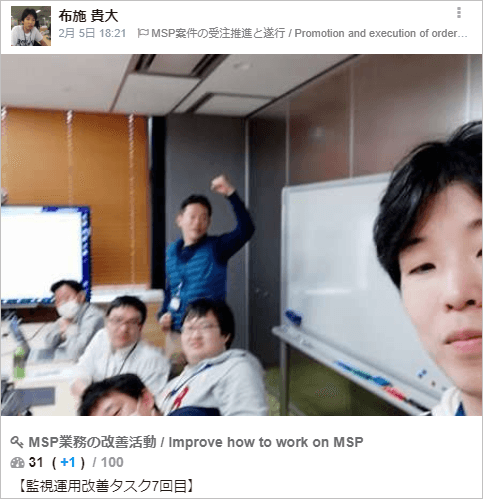 Actual posts. Maybe it was too much momentum, except for Mr. Fuse. [/caption]
Fuse: Before the KPT, even if something came up as a problem, it tended to be left behind, but a culture was created to surface it as a problem and solve it. Through this reflection, I feel that I have become able to work as a team more than before.
Koshiba: That's good!
Just do what is in front of you with normal tension
Koshiba: Is there anything else that is important to you in your work?
Fuse: I don't know if this is a good thing, but my policy is to "create an environment where you don't have to do it yourself." I think I should crush the things in front of me more and more, and look for something else on my own.
Koshiba: It's a movement to structure what is in front of you and pass it on to someone else. Do you like that kind of thing?
Fuse: That's right.
Koshiba: In general, I think there are many people who are afraid of change, or think that it is okay to maintain the status quo, but why doesn't Mr. Fuse do that?
Fuse: Well, I want to contribute to making money, and I think that's what I can do to do that. It's a way of thinking that you do it because it's right in front of you, so you don't have much initiative. Laughter
Koshiba: But you're looking for the next move! That's independence from the perspective of others!
Fuse: I see.
Koshiba: Where did that motivation come from?
Fuse: Motivation doesn't really suit me. For me, it's money, it's something I can do, so let's do it. I'm doing it with that kind of normal tension.

Koshiba: How do you find such things one after another?
Fuse: If you think about it, there are probably quite a few things that can be changed. But it's a little troublesome. It's troublesome, so I'm left a lot of fallen. So I think everyone is really aware of it.
Koshiba: It's like you're turning a blind eye?
Fuse: I think that's what it is.
Koshiba: Huh? My ears are gradually hurting. Laughter
Fuse: I think it would be nice if I could get involved in those troublesome things around me and crush them more and more.
If you understand the other person's intentions in every face-to-face meeting, you can find as many areas for improvement as you want.
Koshiba: Somehow, I feel like I got a glimpse of Mr. Fuse's values in today's interview. Rather than having a very wet team feeling, I would do it if I could earn money and benefit the team...
Fuse: I think you are conscious of thinking about the other person as much as possible. I started to get into this habit after I started playing pachislot.
Koshiba: No way pachislot here!
Fuse: In pachislot, I naturally got into the habit of trying to understand the other person's intentions because I thought that there was a possibility that the store might put a good table here with this intention. Even in my current job, if I have that kind of awareness for all face-to-face meetings, I will definitely see that this is the best way to do it.
Koshiba: The pachislot days were not in vain. Laughter
Fuse: I think so. Laughter

Koshiba: No~ Anyway, I'm glad I was able to recover the foreshadowing of the first pachislot story. It's helpful because I'm not good at thinking about punchlines.
Fuse: Yes, I took Mr. Koshiba's thoughts.
Koshiba: That's right! Jackpot! Laughter
